- Introduction
- The Meaning of Tattoos in Ancient Japan
- Edo Period: Art and Contradiction
- Meiji Era: Modernization and Suppression
- The Yakuza Connection
- Postwar Japan and the Rise of Social Conformity
- Modern Japan: Attitudes Are Changing
- Why Rules Still Exist Today
- What This Means for Travelers
- Internal Links (Suggested Placement)
- FAQ: Common Questions from Travelers
- Conclusion
- References
Introduction
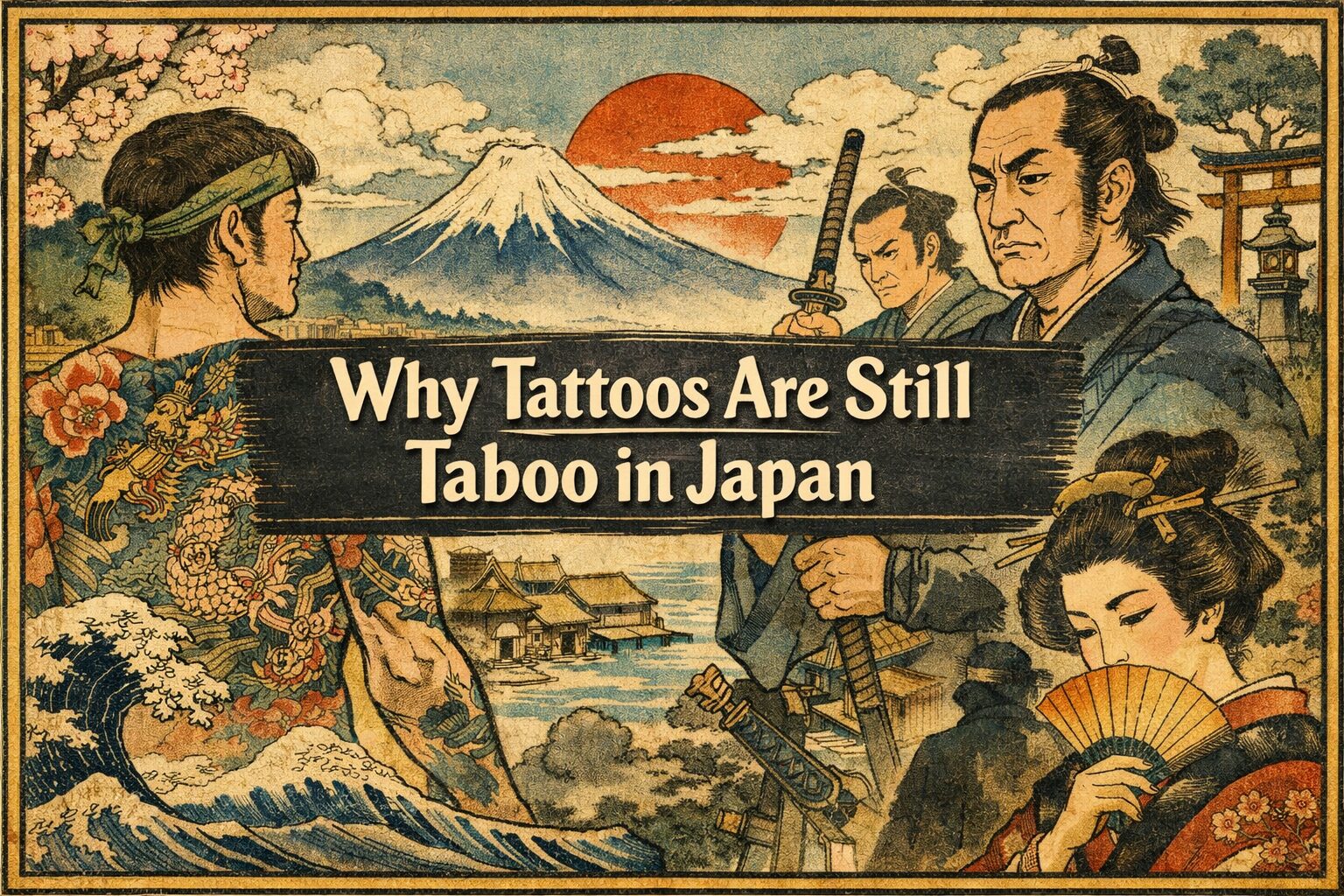
Why are tattoos still taboo in Japan?
For many travelers, this question comes up quickly—sometimes even before booking a trip.
After all, tattoos are common forms of self-expression in many countries. They can represent art, identity, memory, or belief. So why does Japan seem different?
The answer is not that Japan is simply conservative, strict, or unwelcoming.
Instead, the relationship between tattoos and Japanese society has been shaped by history, crime, public order, and social trust over many centuries.
As a Japanese person, I want to explain this topic clearly and calmly—without judgment, exaggeration, or fear.
Understanding why tattoos became sensitive in Japan helps travelers navigate public spaces with confidence and respect.
This article explores:
- How tattoos were used in ancient and early Japan
- Why they became linked to crime and punishment
- How modern Japanese society views tattoos today
- Why attitudes vary by place, generation, and situation
- What travelers should realistically expect
The Meaning of Tattoos in Ancient Japan
Tattoos Before Modern Japan
Tattoos existed in Japan long before they became controversial.
Archaeological evidence suggests that during the Jōmon period (c. 10,000–300 BCE), tattoos may have been used for:
- Spiritual protection
- Social identity
- Decorative purposes
Early Chinese records also mention tattooed people in the Japanese archipelago. At this stage, tattoos were not associated with crime or social stigma.
Tattoos as Punishment (Irezumi Kei)
The major shift happened much later.
During the Kofun to Edo periods, tattoos began to be used as a form of criminal punishment.
Instead of imprisonment, authorities would permanently mark criminals with visible tattoos—often on the arms or face.
These tattoos were meant to:
- Shame offenders
- Make repeat crimes easier to detect
- Permanently separate criminals from society
This practice created a long-lasting association between tattoos and criminal behavior, even after tattoo punishment was officially abolished.
Edo Period: Art and Contradiction
Decorative Tattoos and Ukiyo-e Culture
Ironically, while tattoos were used to mark criminals, they also became popular art forms during the Edo period (1603–1868).
Influenced by ukiyo-e woodblock prints, especially heroic characters from Chinese novels, decorative tattoos spread among:
- Firefighters
- Laborers
- Craftsmen
These tattoos were elaborate, colorful, and artistic—closer to full-body artwork than simple markings.
However, this popularity existed outside mainstream society. Tattooed individuals were admired for bravery or toughness, but still viewed as living on the margins.
Tattoos and Social Boundaries
During the Edo period, Japanese society placed great importance on:
- Social roles
- Order
- Visible conformity
Tattoos blurred these boundaries.
They were neither fully criminal nor fully respectable—and that ambiguity made them uncomfortable for authorities and communities alike.
Meiji Era: Modernization and Suppression
Tattoos Become “Uncivilized”
When Japan entered the Meiji era (1868–1912), the government aggressively pursued modernization.
Western nations were watching, and Japan wanted to be seen as a “civilized” country.
Tattoos were viewed as:
- Primitive
- Backward
- Embarrassing to Japan’s international image
As a result, tattooing was officially banned.
This ban was not about morality—it was about national reputation.
Legal Status vs. Social Memory
Although tattooing was legalized again after World War II, social attitudes did not reset.
The memory remained:
- Tattoos were once illegal
- Tattoos were once shameful
- Tattoos marked people as outsiders
These impressions continued quietly across generations.
The Yakuza Connection
Why This Association Matters
In the 20th century, tattoos became strongly associated with yakuza (organized crime groups).
Traditional yakuza tattoos are:
- Large
- Detailed
- Painfully hand-poked
- Meant to symbolize loyalty, endurance, and identity
Because yakuza were feared and socially rejected, their visual symbols—including tattoos—became symbols of danger in the public imagination.
Public Spaces and Safety
Many public facilities—especially:
- Onsens
- Public baths
- Gyms
- Pools
chose to restrict tattoos not to judge individuals, but to:
- Avoid intimidating other guests
- Prevent conflicts
- Maintain a calm environment
Even today, many of these rules are rooted in risk avoidance, not hostility toward foreigners.
Postwar Japan and the Rise of Social Conformity
Tattoos vs. Group Harmony
After World War II, Japanese society strongly emphasized:
- Stability
- Predictability
- Group harmony (wa)
In this environment, tattoos stood out.
Being visibly different—even without bad intentions—can create discomfort in situations where people expect uniform behavior.
This is not unique to tattoos.
Similar reactions may occur toward:
- Loud behavior
- Ignoring unspoken rules
- Strong individual expression in quiet spaces
Why “Standing Out” Matters
In many Western cultures, standing out is often admired.
In Japan, blending in is usually seen as considerate.
Tattoos challenge that expectation, especially in shared public environments.
Modern Japan: Attitudes Are Changing
Generational Differences
Today, attitudes toward tattoos vary widely.
Younger generations tend to:
- Be more accepting
- View tattoos as fashion or art
- Separate tattoos from crime
Older generations may:
- Still associate tattoos with danger
- Feel uneasy rather than angry
- Avoid confrontation but feel uncomfortable
Both perspectives coexist in modern Japan.
Tourists and International Context
Foreign visitors with tattoos are generally viewed differently from tattooed Japanese nationals.
Many people understand that:
- Tattoos are common overseas
- Cultural meanings differ
- Tourists are not yakuza
However, understanding does not always equal comfort.
This is why reactions may vary silently rather than openly.
Why Rules Still Exist Today
Not About Law, But About Management
It’s important to clarify:
- There is no nationwide law banning tattoos
- Restrictions are usually set by individual facilities
Businesses often choose conservative policies to:
- Avoid complaints
- Protect their reputation
- Create predictable environments
This is especially true for places serving families, elderly guests, or local communities.
Written Rules vs. Social Expectations
Even when rules are not written, social expectations still operate.
This can feel confusing to visitors—but it reflects how Japan often manages behavior through shared understanding rather than enforcement.
What This Means for Travelers
Understanding Over Fear
Tattoos are not taboo because Japan is unkind.
They are sensitive because history gave them meanings that still linger.
Travelers who understand this tend to:
- Feel less anxious
- Interpret reactions more accurately
- Adjust behavior calmly when needed
Respect Is Usually Enough
In most situations:
- Being polite
- Following posted rules
- Responding calmly if asked
is enough to avoid problems.
Aggressive reactions or arguments often cause more discomfort than tattoos themselves.
Internal Links (Suggested Placement)
- Tattoo Cover Seals for Japanese Onsens – for traditional spaces with clear rules
- Can You Go to the Beach in Japan with Tattoos? – for relaxed public environments
- Tattoo-Friendly Onsens in Japan – for travelers seeking guaranteed comfort
(Place naturally where relevant.)
FAQ: Common Questions from Travelers
Q1: Are tattoos illegal in Japan?
No. Tattoos are legal. Restrictions come from individual businesses, not national law.
Q2: Do Japanese people dislike tattooed foreigners?
Dislike is too strong. Some may feel uncomfortable, others do not mind at all.
Q3: Will I be confronted in public?
Very rarely. Most people avoid confrontation.
Q4: Are attitudes changing?
Yes—especially among younger generations and in tourist-heavy areas.
Q5: Should I hide my tattoos everywhere?
No. Adjust only when necessary, and follow local guidance.
Conclusion
Tattoos are still considered taboo in Japan not because of fear or intolerance, but because of history, crime associations, and social expectations built over time.
Understanding this background allows travelers to:
- Interpret rules without frustration
- Respect local spaces without losing themselves
- Enjoy Japan more confidently
Japan welcomes visitors who make an effort to understand—not just to follow rules blindly.
References
- “A History of Tattooing in Japan” — Trippin.World
Explains the long and complex history of tattoos in Japan, including ancient practices, criminal associations, and modern stigma.
https://trippin.world/feature/a-history-of-tattooing-in-japan - “Tattooing in Japan: A Cultural Tapestry” — toki.tokyo
Overview of Irezumi as traditional Japanese tattoo art, its cultural motifs, and historical symbolism.
https://www.toki.tokyo/blogt/2023/8/9/the-art-of-irezumi-a-glimpse-into-traditional-tattooing-in-japan - “Understanding the Legal Status of Tattoos in Japan” — Japan Language Factory
Clarifies the legal status of tattoos in Japan, confirming they are not illegal and explaining venue policies.
https://www.japanlanguagefactory.com/understanding-the-legal-status-of-tattoos-in-japan/ - “Irezumi” — Wikipedia (English)
Encyclopedic overview of traditional tattooing in Japan, including Edo-period punishment tattoos and lingering stigma.
https://en.wikipedia.org/wiki/Irezumi - “Why are tattoos considered a taboo in Japan?” — Japaholic.com
Discusses associations with yakuza and changing social views, including legal developments and tourism context.
https://en.japaholic.com/why-are-tattoos-considered-a-taboo-in-japan/ - “Japanese Onsen and Ink — The Tattoo Taboo” — japan.travel (JNTO blog)
Japan National Tourism Organization explaining how historic associations with organized crime influenced onsen policies.
https://www.japan.travel/en/blog/japanese-Onsen-and-ink-the-tattoo-taboo/ - “The Ainu History and the Art of Tattooing” — Untold Japan
Explains traditional tattoo practices among the Ainu people and their historical suppression.
https://www.untold-japan.travel/post/ainu-history-and-ainu-tattoo

コメント